


Competence and Functions
ADMINISTRATION OF JUSTICE AND FORMATION OF UNIFORM CASE LAW
The Supreme Court of Lithuania is the only court of cassation in the country that examines cassation appeals in criminal and civil cases. Cassation is not possible for decisions of courts of general competence that have not been re-examined by the appellate instance.
The main task of the Supreme Court is to form a uniform case law for courts of general competence in the interpretation and application of laws and other legislation by exercising its special function of controlling the legality of court decisions (cassation).
In carrying out the function of cassation, the Supreme Court does not examine facts – it examines only questions of law. The cases are resolved according to the factual circumstances established by the courts of first and appellate instances, based on which the Supreme Court checks whether the courts did not make mistakes in the interpretation and application of the law. In performing these functions, it is constrained by the limits of the cassation appeal lodged.
The most important result of the cassation is the interpretation and application of the law in a particular case. The Court of Cassation, when dealing with an individual legal dispute, develops in its judgments the law by ensuring that it is interpreted and applied uniformly throughout the country. The interpretations provided by the Supreme Court bind both the court of cassation itself and other courts of general competence that deal with analogous or essentially similar cases. Following the case law established by the court of cassation, stable legal relations and trust in justice, courts, and the state are created.
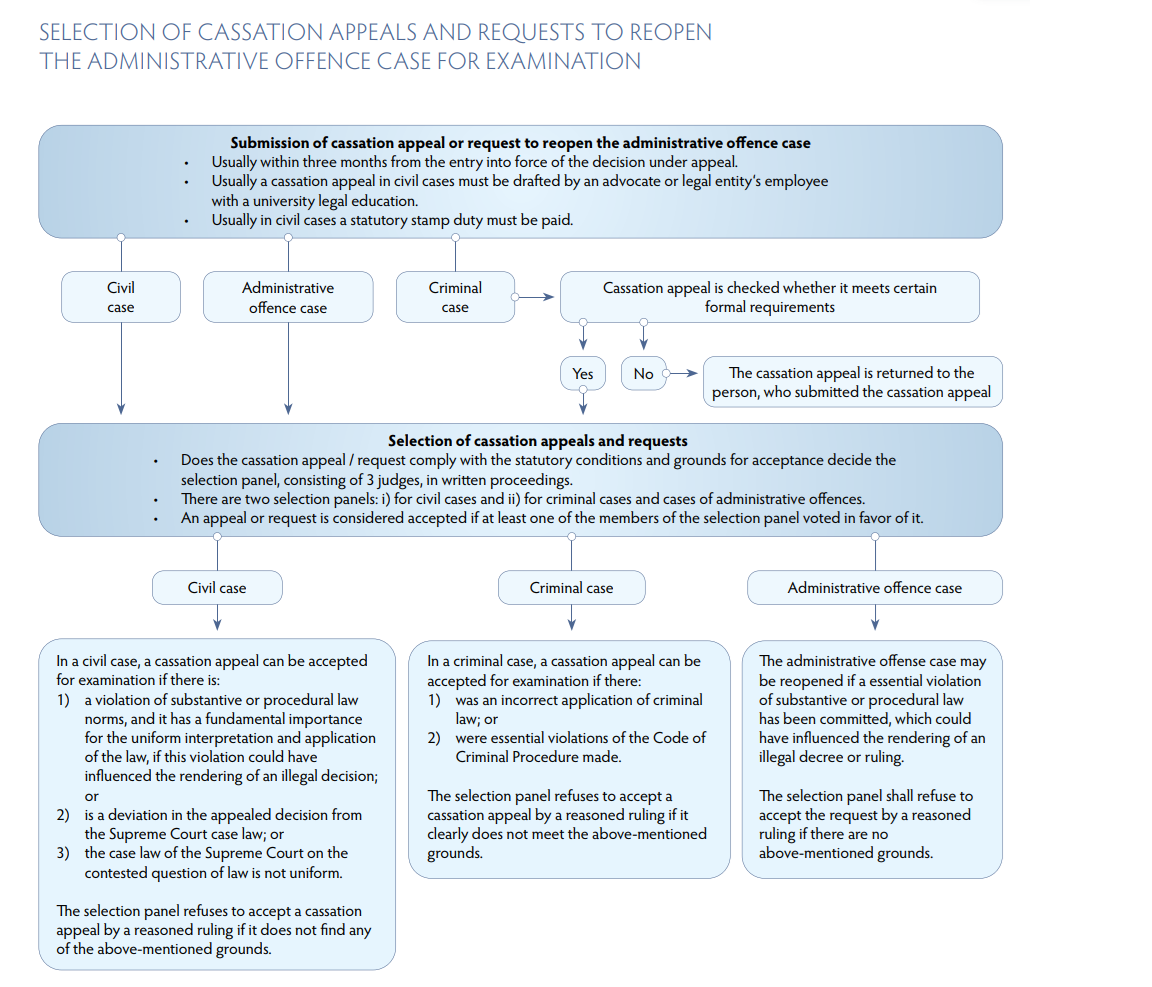
The right to lodge a cassation appeal with the Supreme Court have any persons involved in the case. In order to be accepted for consideration, a cassation appeal must meet the requirements established by the law. The review of the admissibility of lodged cassation appeals is performed by a special three-judge panel (selection panel) of the Criminal Division or Civil Division of the Supreme Court, respectively. During the selection process, the case is not resolved – at this phase, it is only assessed whether the statutory conditions and grounds for reviewing the case in the cassation procedure are present. After determination that the cassation is possible and accepting the cassation appeal, the case is transferred to the panel of judges for consideration on merits.
In addition to cassation, the Supreme Court is entrusted with another important function – to decide on the issue of reopening a resolved case of administrative offenses, when a fundamental violation of substantive or procedural law was committed during the rendering of the court’s decision. The question of the admissibility of the application is resolved by a special selection panel, which, as in the case of cassation, assesses whether the conditions and grounds established by law exist for transferring the case to a panel of judges for consideration on merits.
The Supreme Court also resolves issues regarding reopening of administrative offence, criminal, and civil cases, when the European Court of Human Rights recognizes that the decisions of the courts of the Republic of Lithuania contradict the Convention on the Protection of Human Rights and Fundamental Freedoms (in administrative offence and criminal cases – also in the event that the Human Rights Committee of the United Nations recognizes that the decision to bring a person to justice was made in violation of the International Covenant on Civil and Political Rights), or when the Constitutional Court of the Republic of Lithuania recognizes that a certain law or other legal act contradicts the Constitution of the Republic of Lithuania and, based on this legislation, the court rendered a decision in a specific case of a person and this decision violates the constitutional rights or freedoms of this persons; it also decides on reopening of the criminal case due to newly discovered circumstances or clearly inappropriate application of the criminal law; and on reopening of the civil case, when the case was examined by a panel of judges of the Supreme Court of unlawful composition.
The Supreme Court also participates in the process of civil rights restoration (rehabilitation) of persons repressed for resisting the occupation regimes of the Soviet Union or Nazi Germany – it issues rights restoration certificates, examines appeals regarding the decision to issue or refusal to issue a certificate, and application on reopening of civil rights restoration case on the grounds and in accordance with the procedures laid down in the special law. The Supreme Court also hears complaints upon the results of the evaluation of candidates for judges (due to essential violations of the procedure) and complaints on the decisions of the Court of Honour of Judges, which hears disciplinary cases of judges.
PROCEEDINGS OF CASES IN THE SUPREME COURT
Cases in the Supreme Court are usually heard by a three-judge panel of the Criminal Division or the Civil Division, respectively.
An extended panel of seven judges or a plenary session of any division, as well as a mixed panel of three or an extended panel of seven judges or a plenary session of the entire Supreme Court may be formed to resolve a case. These are usually cases when the proper application of a substantive or procedural provision of law in a case would mean a new interpretation of the provision of law in court practices or a basis for deviating from the formed case law of the Supreme Court is possible, or when a complex question of interpretation and application of the law has arisen in the case.
Cases are usually assigned to judges by the Chairperson of the division in an automated manner, using a computer program – the Case Assignment Module of the Lithuanian Court Information System (LITEKO).
The main criteria by which the computer program selects a specific reporting judge are the specialization of the judges, the workload of the judges, the complexity of the cases previously assigned to the judges, and the factor of randomness. The cases are assigned according to the lists of panels of judges created automatically by the same program. Thus, after the computer program selects the reporting judge, the case is assigned to the panel of judges of which the reporting judge is a member, except for cases where a specific judge cannot consider the case for reasons specified in laws or other legislation. The case assignment procedure is recorded in the program protocol, which is publicly available on the website of the Lithuanian courts. Every interested person can find out how the judge handling a specific case was appointed, whether there was a deviation from the proposal of the computer program, and if such, what were the reasons for that. This program allows to ensure the independence of the courts, the impartiality of judges, their workload, and the transparency of the assignment of cases.
Administrative offense and civil cases are usually examined by written procedure, except in cases where the panel of judges decides that an oral hearing is necessary. Criminal cases can also be examined by written procedure, with the exception established by law (e. g., when a cassation appeal is filed on grounds that worsen the situation of the convicted/acquitted person).
Decisions in the case are taken by majority vote. A judge who disagrees with the decision has the right to express his dissenting opinion in writing. The dissenting opinion of the judge shall be annexed to the file.
The decision of the Supreme Court must be delivered and published in the shortest time possible, but no later than within 45 days in a criminal case, within 30 days in a civil case, and within 30 days in a reopened administrative offence case, from the date of the hearing of the case.
The decisions of the Supreme Court contain reasoned answers, based on relevant interpretation and application of the law, to the arguments of the cassation appeal.
After examining the case and finding that an error of law has been committed, the Supreme Court may annul the judgment under appeal and refer the cassation case back to the court of first instance or the court of appeal, modify the judgment(s), or overturn the judgment of the court of appeal and uphold the judgment of the court of first instance. In reopened administrative offence and civil cases, the Supreme Court can also render a new decision. The described powers of the Court create conditions for an effective examination of the case, since the Supreme Court itself can correct the identified errors without returning the case to the court of first or appellate instance for re-examination.
If the case is returned to the court of the first or appellate instance for re-examination, the instructions and interpretations set out in the ruling of the court of cassation are binding on the court re-examining the case. Adherence to these provisions contributes to the clarity of decisions of the Supreme Court and makes it easier to identify and follow interpretations that have most important precedential value.
ACTIVITIES RELATED TO THE ADMINISTRATION OF JUSTICE
In addition to the administration of justice, the Supreme Court also:
- analyses national case law as well as case law of European Union and international courts, other sources of law, prepares case law summaries and reviews;
- periodically publishes the bulletin “Court Practice”, which presents the current case law of the Court of Cassation, summaries of case law and reviews approved by the relevant division of the Supreme Court. The bulletin also publishes summaries of the decisions of the European Court of Human Rights and the Court of Justice of the European Union that are most relevant to the case law;
- publishes an annual overview of its activities every year, in which most significant jurisprudence and work done is presented.


Contacts
The Supreme Court of Lithuania
Gynėjų 6, 01109 Vilnius
Telephone +370 5 2 616 466
Email [email protected]
Code 188602032
E. pristatymas (Electronic delivery system) details:
name – Lietuvos Aukščiausiasis Teismas
address – 188602032
Budgetary institution
Data is collected and stored in the Register of Legal Entities,
Code 188602032
Working hours
I-IV 8.00 – 17.00
V 8.00 – 15.45
Lunch break
12.00 – 12.45
Documents can also be submitted during the lunch break

Website Compliance Application (in Lithuanian)
Publications

Map of courts

